




The Paper Upload method is crucial for aviation compliance in contemporary times. As regulatory frameworks improve, records are being digitally submitted to improve accuracy and efficiency. Aircraft owners, manufacturers, operators, and others involved in aviation use secure uploads for forms, supporting records, and legal documents.
Timely and proper document upload allows filings to be received, reviewed and recorded without delay. If there’s a mistake in the filing, it will either be rejected or take longer to process. For this reason, it is essential to understand how the upload works.
The FAA uses online document upload systems to manage many aviation records. These include registration, changes in ownership, security filing and evidence. Each submission forms part of an official record that can affect the aircraft’s status or legal standing.
Documentation upload is detail explained in this article. This material will review the purpose of the digital submission, standards required, common issues faced and best practices. If all stakeholders in aviation know the process. They can submit documents without hesitation. Also, stay compliant with regulations.
How to upload documents to the FAA
The ability to upload documents allows operators to electronically submit aviation records for review. It replaces several submissions in paper form to enhance speed and traceability.
Uploaded files are kept as part of a central system Each file must be complete, accurate, and formatted correctly before acceptance. This will ensure uniformity in aviation records.
Safety improves through digital submission. Uploaded Files Are Recorded, Timed And Linked To A Transaction. It minimizes the possibility of losing or misfiling documents.
| Feature | Description | Benefit |
| Electronic Submission | Digital file upload via FAA portals (IACRA, AME hubs). | Faster Processing: Eliminates mail transit and manual data entry delays. |
| Secure Storage | Encrypted repositories with role-based access control. | Data Protection: Safeguards PII (Personally Identifiable Information) and sensitive data. |
| File Validation | Automated review of file formats and mandatory fields. | Fewer Errors: Rejects non-compliant files instantly to prevent long-term delays. |
| Tracking Capability | Real-time status updates and submission receipts. | Better Transparency: Users can confirm receipt and monitor the review lifecycle. |
This structure helps keep reliable records with less paper work.
Significance of Document Upload in Aviation Compliance
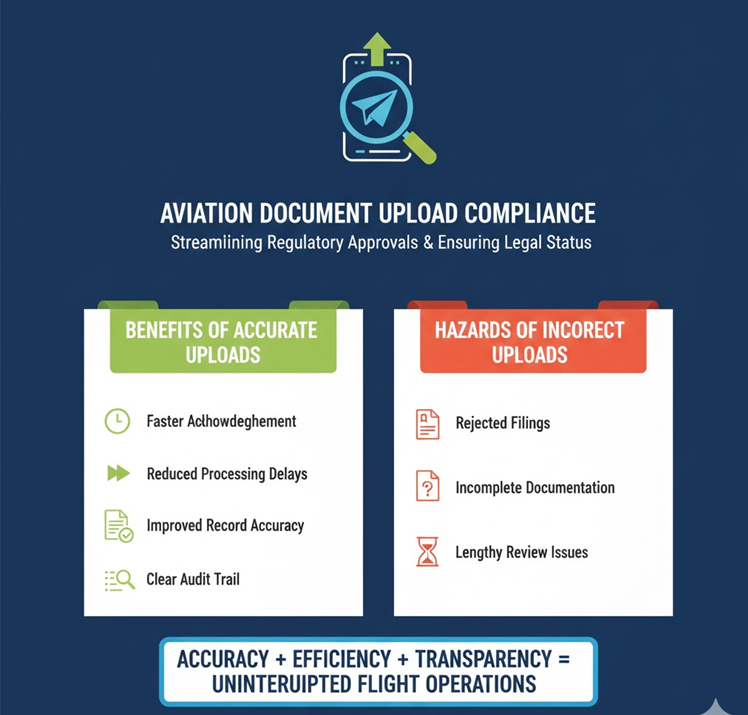
Upload documents as they matter for your aviation compliance. If submissions are delayed or incorrect, this may impact aircraft operations or legal status.
Regulators can now check documents faster through digital uploads. Consequently, there are no additional unnecessary filings to be handled.
Owners of the aircraft rely on document upload. Submissions are entered instantly instead of through mail delivery. This gives more assurance records are received.
The following two short lists illustrate the difference between correct uploads and poor submissions.
Benefits of Accurate Document Upload
- Submission acknowledgement faster.
- Decreased processing delays.
- Better Record Accuracy
- Have an unambiguous audit trail.
Hazards of Incorrect Uploads
- The filings were rejected.
- Insufficient documentation.
- Lengthened time for reviews.
- Conformance issues.
The significance of document upload accuracy in aviation administration should not be overlooked.
Uploading Documents versus Traditional Paper Submission
There’s a significant difference between uploading a digital document and submitting papers through the traditional way. The below comparison highlights speed, reliability and compliance impact differences.
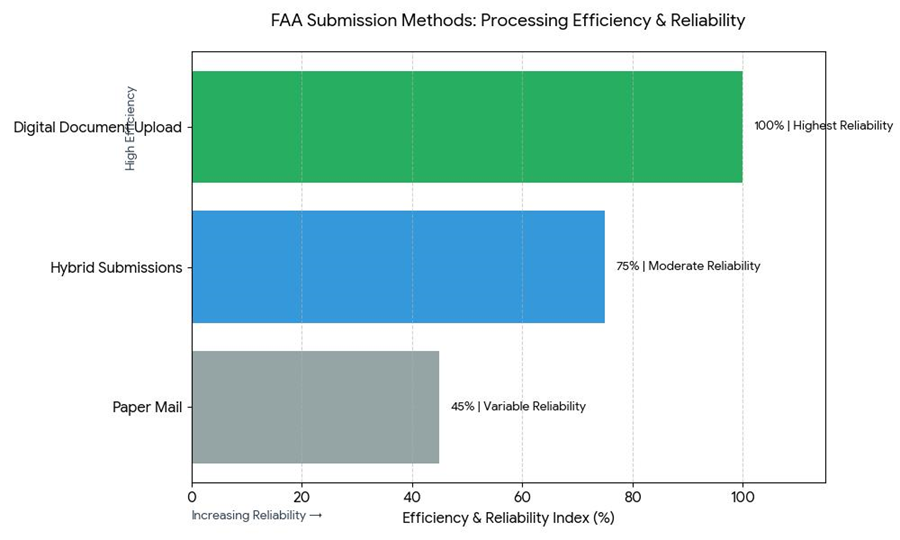
- Near-Instantaneous Turnaround: Submission by Digital Document Uploads (DDU) achieves maximum (100%) efficiency, thereby avoiding the postal system stream. This allows the FAA to commence the review as soon as you hit submit.
- The “Validation Safety Net”: The Validation Safety Net: Paper mail can be turned away weeks later due to a typo or missing detail. The portals provide real-time validation. Systems catch missing fields or wrong formats in real-time, and hence have a much higher first pass approval rate.
- End-to-End Transparency: You will receive an electronic receipt and a tracking number for every digital submission. This lets owners see the precise phase of their application in the queue, eliminating the uncertainty of mail getting there early or not.
Uploading online boosts speed and reliability. Submissions of documents in physical forms which makes them increasing chances of delay or loss.
This comparison illustrates why aviation filings are now submitted predominantly through document upload.
Essential requirements for effective document upload
Effective document uploading requires paying attention to some details. The overall acceptance depends on file format, clarity and, completeness.
Documents must be scanned properly and readable. In case the pages are not blurred or incomplete, the same might get rejected. Consistent file naming makes it easy for reviewers to identify records.
Type of File and Quality
Common formats include common digital document formats. Make sure each file is clear, complete, and oriented.
Content correctness
The documents that you upload must be consistent with the information in the related form. Differences may postpone the review or elicit follow-up requests.
The regulatory authorities review your uploaded records or documents after validating your requirements.
Document Upload in Aviation – Common Use Cases
Uploading documents supports several aviation transactions. It includes Initial registrations, ownership updates, and security filings.
Supporting documentation often accompanies the primary forms. Uploading these records together will improve their review and decrease requests for further information.
Two examples display common situations
- Submissions related to registration
- The submissions of legal and financial recordings.
Proper upload ensures the availability of all required details in each case for review.
Guide to Successful Document Upload in a Website
If you follow the best practices for document upload, submission will not issue. Preparation and review are essential steps.
Staff should ensure documents are accurate and complete before upload. Check that nothing is missing and all is clear.
Two focused lists summarize best practices and common mistakes.
Tips for Uploading Documents
- Inspect documents prior to submission.
- Ensure scans are clear and readable.
- Confirm correct file formats.
- Always keep copies for your records.
Frequent Upload Errors
- Turning in partial documents
- Employing inferior quality scans.
- File naming is incorrect.
- Uploading the incorrect file
Compliance with best practices avoids causing delay to the processing.
How Document Uploads Help Record Transparency
Uploading of documents promotes transparency via a clear digital trail Every entry is stamped with date, time and code.
It is beneficial to both regulators and aircraft owners. It makes audits or reviews easier since it is easy to reference.
Digital records also improve future access. It is easier to pull files which are stored online than paper archives.
The benefits mentioned demonstrate that a document upload is crucial in aviation.
Handling Mistakes and Fixes in Document Upload
Document upload may still have errors. Identifying them and fixing them is necessary.
If the document is rejected, the cause is generally a formatting or information defect. Going over feedback carefully prevents repeat problems.
Giving prompts corrective measures cuts down delays while maintaining compliance. This above approach aids in the effective resolution of submission queries.
How Document Uploading Enhances Regulatory Efficiency
Uploading documents enhances regulatory efficiency by streamlining review processes. Reviewers can access records instantly with digital systems.
This capability cuts down processing times while upholding uniform standards. It can also handle greater submission volumes without a corresponding rise in admin work.
These will result in quicker outcomes and clearer expectations for the aviation community.
Importance of Document Upload in Aviation Industry
Document upload is a crucial aspect of aviation compliance and record keeping. National Aviation Center It assists in getting faster turnaround time, higher accuracy and transparency which is difficult with traditional methodologies.
By understanding the requirements and best practices, aircraft owners and professionals can submit records with confidence. A thorough preparation removes mistakes and makes reviews easier.
With changes in aviation systems, document upload will still be important for review. Stakeholders who master this can remain compliant while leveraging efficient digital processes.
An efficient document upload procedure ultimately ensures a safer, more transparent and better aviation governance.