


The Airworthiness certificate FAA process is a necessary requirement for aircrafts to be permitted to fly in the USA. An aircraft can be certified for airworthiness for which it has to be approved a design standard. No civil aircraft shall fly without such authorization, regardless of ownership or purpose.
The process can be far more structured than most aircraft owners, operators and builders appreciate. Before granting approval, the FAA scrutinizes documents, health status, and history of compliance. Even small records or maintenance gaps can delay certification.
Being acquainted with airworthiness certificate FAA process will avoid costly grounding and repeating inspections. Inspectors and facility maintenance professionals work better together. The certification is exhaustive whether it is certification of a newly manufactured aircraft, an imported aircraft, a rebuilt aircraft or modified aircraft.
The article details complete procedure, types of certificates, comparisons, inspection steps and practical guide. This guide helps aircraft owners navigate the certification process with clarity and confidence.
Summary of the FAA Process for Airworthiness Certificate
The airworthiness certificate FAA process assesses whether an aircraft conforms to its approved design and is safe to operate. All aircraft certified under this standard adopt the protocol.
After reviewing records and completing inspections, the FAA gives airworthiness certificates. The type certificate or approved configuration must match the aircraft.
Standard and special are the two principal certificate categories. Most factory-built aircraft are subject to standard certificates. The FAA must issue special certificates to cover experimental, restricted, and other special operations.
| Certificate Type | Typical Aircraft | Operational Scope | Duration |
| Standard | Factory-built (Cessna 172, Boeing 737, etc.) | Full civil operation: Passenger/cargo transport, flight instruction, and commercial hire. | Ongoing (Indefinite as long as maintenance and ADs are followed). |
| Special | Experimental, Restricted, Light-Sport, or Limited. | Limited operations: Research, exhibition, amateur-built, or specific work like crop dusting. | Varies: Indefinite for amateur-built; often 3 years for R&D/Market Survey. |
| Provisional | Newly designed aircraft undergoing testing. | Limited to testing: Flight trials and crew training before full type certification. | Limited: Usually expires upon issuance of a Standard certificate or a set date. |
Continuous compliance is mandatory for both. Continuing maintenance and inspections after issuance.
Essential Criteria and Examination Phases
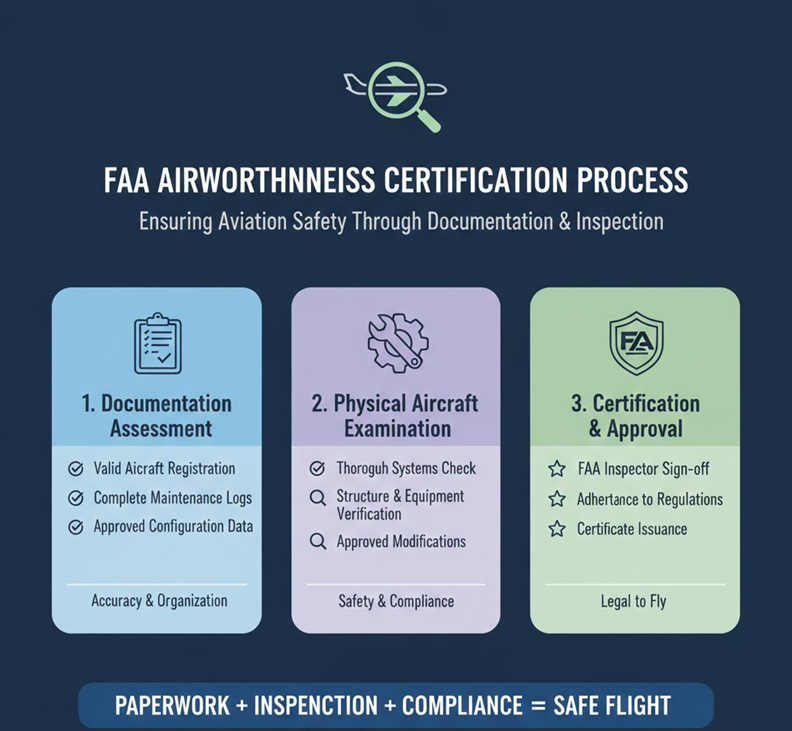
The FAA evaluates both paperwork and the actual plane to certify it as safe to fly in an airworthiness certificate FAA process.
All the stages confirm to the safety dates.
Assessment of documentation
FAA inspectors check maintenance records, registration status, and conformity documents. Such documents confirm the identity and configuration of the aircraft
Insufficient and inconsistent documentation often lead to delays. It is important to stay accurate and organized.
Examination of Aircraft
The plane goes through a thorough physical checkup. These inspectors verify the systems, structure and installed equipment.
The authority confirms that the changes meet approval requirements and records them properly. Reviewers must fix any errors before granting approval.
These are often required
- Valid registration of aircraft.
- Maintenance logs must be complete.
- Configuration Data Approved
- This follows the relevant guidelines.
Comparing Standard and Special Airworthiness Certificate
Regulators require different certification approaches for various aircraft missions. By understanding the differences, they choose the right path.
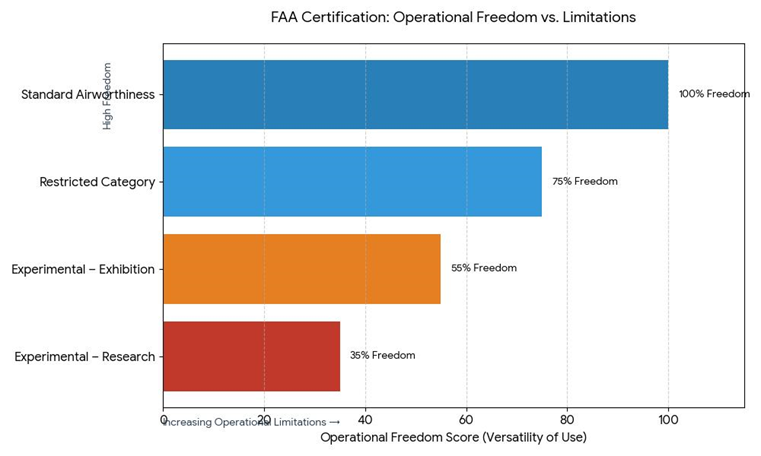
· Unrestricted Commercial Utility: With a Standard Airworthiness Certificate, you can conduct 100% business activity. This is the only type of certificate permissible for the commercial movement of people and goods, flying training and international civil flying.
The “Restricted” Compromise: Aircraft in the Restricted Category (with 75% freedom) serve high-performance, mission-specific roles such as crop dusting and firefighting. Although they perform powerfully within their niche, operators may not carry passengers or fly over congested urban areas.
Experimental Constraints: The Experimental – Research category (35% freedom) and Exhibition category impose the highest level of restrictions. Owners must carry FAA Operating Limitations on board at all times. Operators typically keep these aircraft within restricted test areas or designated flight corridors.
The highest operational freedom is provided by standard certificates. Special certificates allow operation but under defined limitations.
An experimental aircraft may only have a flight for testing or demonstration. An aircraft can conduct commercial operations if it is standard certified.
A comprehensive guide to the FAA Airworthiness Process.
There is a clear sequence for the FAA process. Comprehending every stage minimizes ambiguity.
Scheduling and Application.
The owner submits an application for certification. This encompasses information and documentation of aircraft.
An FAA representative will schedule the date of inspection. Ready yourself before the inspection.
Check and Discovery
Evaluating the records and condition of the aircraft.
Essential checklists aid success for small-business owners.
Must-Have Pre-Inspection Preparation
- Check whether the maintenance records are up to date.
- Check that the configuration matches the approvals.
- Rectify The Known Discrepancies
- Get the plane ready for inspection.
Best Practices After the Inspection
- Store the inspection records safely.
- Monitor current adherence needs.
- Plan future inspections as needed.
- Keep Your Configurations Right.
Continuing these operations assures long-term airworthiness.
Guaranteeing Safety and Compliance Forever
Getting an airworthiness certificate from the FAA is not just a paperwork step. It proves that an aircraft is airworthy and legally permitted to fly.
If owners understand requirements about certificates and inspection stages, delays and more reviews can be avoided. National Aviation Center For success, all your preparations and proper documentation should take place, and maintaining proactively must also be done.
Once the certificate is issued, continuity of compliance must be maintained. Keeping everything normal and properly recorded keeps it operative.
When aircraft owners take the time to complete a structured registration, they help protect safety, value, and compliance. A properly issued airworthiness certificate reflects aircraft integrity and demonstrates responsible ownership.